T-Mobile's T-Satellite Struggles: A Lesson in Consumer Engagement
Despite its innovative efforts, T-Mobile's T-Satellite service has faced challenges in attracting a broader user base, particularly among customers of rival networks like AT&T and Verizon. With CEO Srini Gopalan acknowledging that the service's usage remains largely confined to national parks, T-Mobile's next steps focus on simplifying the enrollment process to entice more users.
Simplifying the Sign-Up Process
AT&T and Verizon users can now easily sign up for T-Satellite online. | Image by T-Mobile
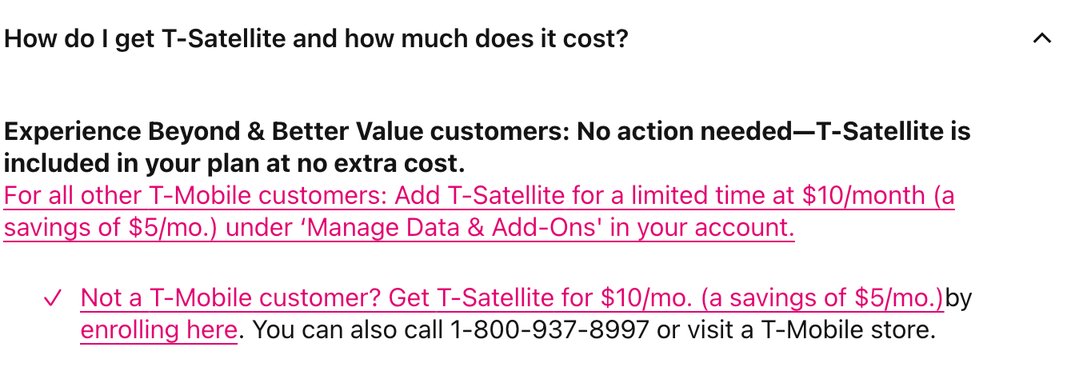
T-Mobile has now made it possible for all users, including those from AT&T and Verizon, to enroll through its website. This change follows an earlier phase that limited online enrollment, which may have contributed to lower adoption rates among users of competing networks.
Bringing Attention to T-Satellite
T-Satellite availability | Image by T-Mobile
Verizon already provides limited satellite services, yet T-Mobile aims to lead the market with its comprehensive offerings, which include messaging support and data apps. Recent partnerships have also extended T-Satellite's reach to locations in Canada and New Zealand. However, AT&T and Verizon users have shown a tepid response towards integrating satellite functions on their devices through T-Mobile.
With the service priced at $10 per month for non-T-Mobile customers, there is potential for T-Mobile to broaden its user base and generate additional revenue. Currently, T-Mobile customers make up over 71% of T-Satellite's connections.
Understanding the Market Demand
T-Mobile may need to consider adjusting its pricing strategy to stimulate greater interest among prospective users. Streamlining the registration process is certainly a step in the right direction, but redefining its pricing could further enhance appeal and adoption rates.