WhatsApp users have long been able to share photos, videos, and voice notes that vanish after being viewed, and now that same ephemeral capability is extending to plain text. After months of internal testing, the Meta-owned messaging giant is rolling out view-once text messages to beta testers on Android, giving users a new way to share sensitive information without leaving a permanent record.
According to a report from WABetaInfo, the feature has started appearing for select users running WhatsApp beta version 2.26.45.6 on Android devices.
Sending a text that disappears: How it works
The mechanics of view-once texts mirror those of disappearing media. Once the recipient opens and reads the message, it is permanently removed from their device, leaving no trace in the conversation history.
Using the feature is straightforward: compose your message as usual, then long-press the send button and choose the "View Once" option from the menu that appears. On first use, WhatsApp will display an explainer detailing how view-once texts behave—simply tap "OK" to continue.
Unlike standard messages, a view-once text doesn't display its contents directly in the chat thread. Instead, the recipient must tap the message bubble, which launches a dedicated full-screen viewer. Once that viewer is closed, the message cannot be reopened. Senders are notified when the message has been read, though this depends on both parties having read receipts turned on.
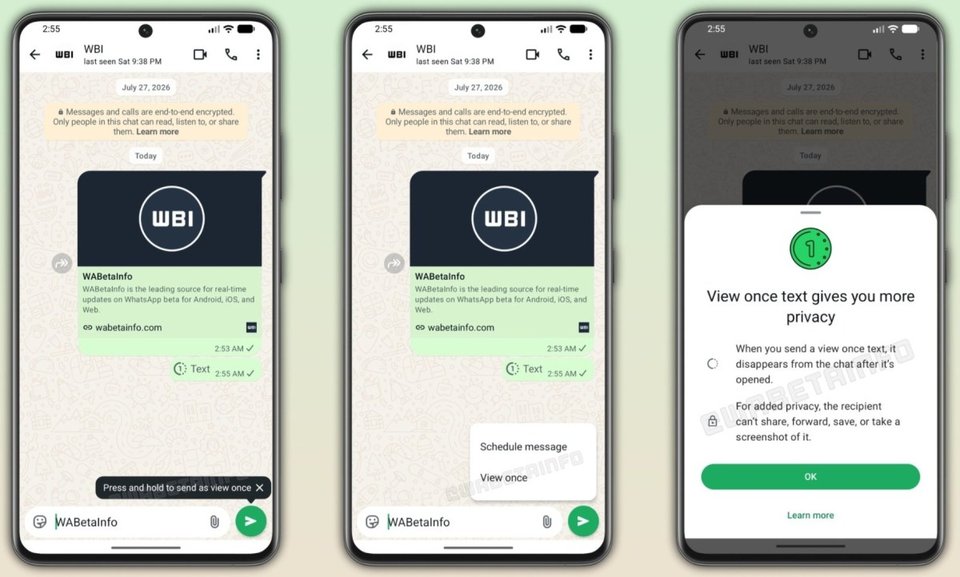
Security protections extend beyond simple deletion. View-once texts cannot be copied, forwarded, or saved, and WhatsApp actively prevents screenshots and screen recordings within the app while the message is being viewed. These safeguards make the feature well-suited for sharing passwords, one-time codes, or other confidential details. That said, no digital protection is foolproof—a recipient could always photograph the screen with a second device, a limitation neither WhatsApp nor the sender can prevent.
One notable restriction, as highlighted by WABetaInfo, is that view-once texts currently cannot be scheduled in advance. It remains unclear whether WhatsApp plans to add scheduling support before the feature reaches a wider audience.
With the feature now in beta testing, a public rollout for all Android users—and eventually iOS—likely isn't far behind.