One of the best perks of owning an electric vehicle is the ability to pre-heat the cabin remotely, letting you step into a warm car on a chilly morning. However, cold temperatures take a serious toll on battery performance, and drivers counting on their EV's official range figures during winter months may be in for a surprise. The question is: just how much range should you realistically expect to sacrifice?
To answer that, a team of Chinese automotive journalists put dozens of popular electric vehicles through a rigorous cold-weather evaluation. While the lineup naturally leans heavily toward domestic Chinese brands, several well-known international models were included as well.
The test involved 45 vehicles driven in ambient temperatures of 8-10 °C. All cars ran with regenerative braking set to maximum, climate control at 25 °C in economy mode, all-season tires, and eco-driving mode engaged. Testing covered three distinct driving scenarios: urban driving at 30 km/h over 100 km, mid-speed driving at 60 km/h over 100 km, and highway cruising at 100 km/h over 153 km. While 8°C hardly qualifies as extreme winter conditions, it proved sufficient to highlight meaningful differences in how various manufacturers' vehicles cope with falling temperatures.
The standout performer was the BMW i3 eDrive 35L, which claimed the top spot by holding onto 80.5% of its rated range, delivering an actual 424 km. Hot on its heels were the Ford Mustang Mach-e GT at 79.7% and the Nio ET5 at 79.0%, rounding out the podium.
Across the 14 BEVs ranked, the majority managed to preserve somewhere between 70-80% of their advertised range. At the other end of the spectrum, the Volvo XC40 and Arcfox aS HI fared the worst, shedding roughly 40% of their claimed figures.
| Model | kWh/100 km @ 30 km/h | kWh/100 km @ 60 km/h | kWh/100 km @ 100 km/h | Actual range | % of advertised range |
|---|---|---|---|---|---|
| BMW i3 eDrive 35L | 15.6 | 15.6 | 18.8 | 424km | 80.5% |
| Ford Mustange Mach-e GT | 17.4 | 20.5 | 25.0 | 392km | 79.7% |
| Nio ET5 100 kW | 16.8 | 16.3 | 21.0 | 561km | 79.0% |
| BMW iX3 | 18.3 | 17.5 | 21.5 | 422km | 78.8% |
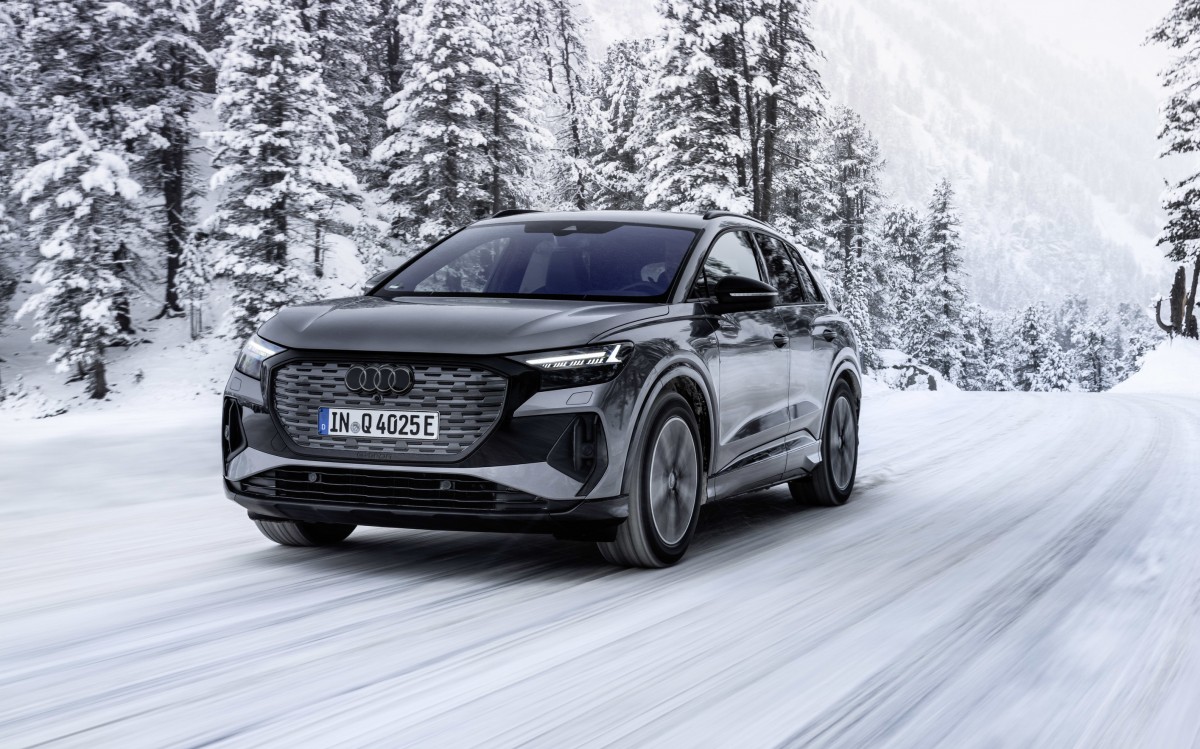
| Audi Q4 e-tron 40 | 14.7 | 18.1 | 23.2 | 470km | 77.7% |
| Zeekr 001 4WD YOU | 20.2 | 18.5 | 23.8 | 485km | 74.5% |
| IM L7 | 19.2 | 19.4 | 23.6 | 452km | 73.5% |
| Rising Auto R7 | 19.3 | 18.9 | 24.4 | 437km | 72.1% |
| Nissan Ariya 87kWh | 22.1 | 22.4 | 28.3 | 376km | 70.5% |
| Polestar 2 LR FWD | 18.3 | 19.9 | 23.1 | 387km | 68.3% |
| Maxus Mifa 9 | 23.5 | 23.0 | 30.3 | 357km | 66.2% |
| Cadillac Lyriq RWD | 21.4 | 20.8 | 25.4 | 427km | 65.4% |
| Volvo XC40 Recharge SR RWD | 19.0 | 19.7 | 24.7 | 331km | 60.2% |
| Arcfox aS HI | 24.1 | 23.8 | 27.8 | 297km | 59.3% |
Interestingly, energy consumption at 30 km/h and 60 km/h proved nearly identical for most vehicles, since the demands of cabin heating effectively canceled out the added aerodynamic resistance at the higher speed. Highway driving at 100 km/h, however, was another story entirely — nearly every vehicle pushed past 20 kWh/100 km. The lone exception was the BMW i3, which posted a remarkable 18.8 kWh/100 km at highway speeds.
Turning to plug-in hybrids and extended-range EVs, results were fairly uniform, with most models holding onto approximately 70% of their rated electric-only range.
| Model | Advertised battery range | Actual battery range | % of advertised range |
|---|---|---|---|
| Geely Emgrand L Leishen Hi-P | 100km/62mi (NEDC) | 55km/34mi | 54.6% |
| Changan Deepal SL03 | 200km/124mi (CLTC) | 136km/85mi | 68.2% |
| Haval H6 | 110km/68mi (NEDC) | 73km/45mi | 66.3% |
| BYD Song Plus | 110km/68mi (NEDC) | 94km/58mi | 85.2% |
| Geely Monjaro Hi-P | 245km/152mi (CLTC) | 167km/104mi | 68.3% |
| Wey Mocha | 175km/109mi (CLTC) | 149km/93mi | 85% |
| AITO M5 | 170km/106mi (CLTC) | 133km/83mi | 78.4% |
| Lynk & Co 09 | 190km/118mi (CLTC) | 140km/87mi | 73.8% |
| AITO M7 | 200km/124mi (CLTC) | 125km/78mi | 62.3% |
| Li L8 | 210km/130mi (CLTC) | 152km/94mi | 72.2% |
| Li L9 | 215km/134mi (CLTC) | 153km/95mi | 71% |
If you'd like to dig deeper, you can watch the original video — it's in Chinese, though English subtitles are provided.
And if your particular vehicle didn't make the list, don't worry. Our nifty tool can project real-world EV range across a much broader spectrum of temperatures (down to -30 °C) and driving speeds, and it covers many more models available in Western markets.