When Steve Jobs unveiled the iPhone at Macworld in January 2007, it instantly became a cultural phenomenon, reshaping the technology landscape forever. Before the iPhone, the Apple iPod had already proven to be a game-changer by selling 450 million units worldwide before Apple discontinued it in 2022.
Not Every Apple Product Hits the Mark
While Apple is renowned for its lineup of successful devices, not every product has been warmly received. One notable example is the Newton, a PDA released in the early 1990s that featured handwriting recognition — a groundbreaking idea at the time, but one that unfortunately delivered poor performance. Priced at $699, the Newton was deemed too costly and was eventually discontinued by Steve Jobs. However, the Newton’s ARM-based processor architecture laid the foundation for Apple’s powerful A-series and M-series chips that power today’s iPhones, iPads, and Macs.
Interestingly, many engineers who worked on the Newton later contributed directly to the development of the iPod and iPhone operating systems, including innovations like app-based interfaces and touch gestures, which first appeared on the Newton.
Post-iPhone Successes and a Notable Misstep
After the iPhone’s success, Apple launched several hit products such as the iPad, Apple Watch, AirPods, and AirTags. However, their smart speaker, the HomePod, failed to achieve the same levels of popularity. Entering a market established by Amazon’s Echo, the HomePod initially struggled to capture a substantial share. By September 2018, it only held around 6% of the market, and just 2% of Apple owners had purchased one.
Siri’s inability to rival the voice assistant capabilities of Amazon Alexa and Google Assistant was a major factor behind the HomePod’s lukewarm reception.
Smart Speaker Ownership Poll
Among ten voters, results showed: Google Nest and "What's a smart speaker?" tied at 30% each, Apple HomePod and Other at 20% each, and no votes for Amazon Echo.
A smart speaker combines traditional speaker functions with digital assistant capabilities. Users can verbally request music streams, news, sports updates, and more. Apple released the original HomePod in February 2018 at $349 (later reduced to $299), making it significantly pricier than competing smart speakers priced between $50 and $100. Apple eventually discontinued the original HomePod, likening its fate to the Newton — buried in Apple’s history.
In November 2020, Apple launched the HomePod mini, a smaller, more affordable version priced at $99. While this helped improve sales, many Apple users remain hesitant about adopting even the mini version.
Apple Users Still Prefer Competitors’ Smart Speakers
Despite the HomePod mini’s commercial improvement, data from the Consumers Intelligence Research Partners (CIRP) reveals that a substantial number of Apple device owners continue to favor Amazon Echo and Google Nest speakers rather than Apple’s own smart speaker products.
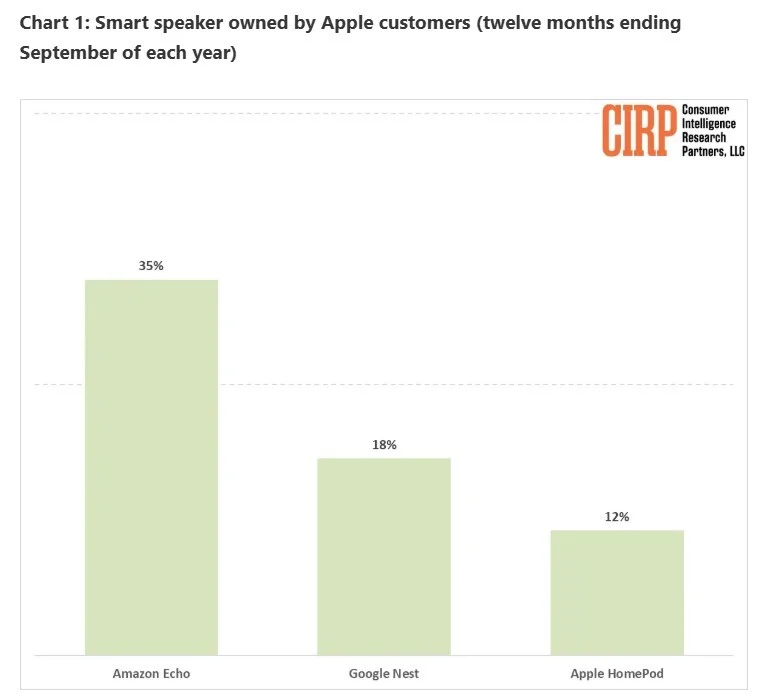
Data from CIRP shows limited interest in the HomePod among Apple users.
Looking at recent surveys of new Apple device buyers, Amazon Echo remains the most popular smart speaker, owned by 35% of these users. Google Nest follows, with the HomePod trailing in third place — holding only a 10-12% share among this group.
Why Are Apple Customers Reluctant?
Apple’s customers have earned a reputation for brand loyalty, making this trend especially surprising. The main reasons appear to be price sensitivity and Siri’s continued lag behind Alexa and Google Assistant in voice recognition and smart home integration.
The HomePod mini at $99 still costs roughly twice as much as entry-level Echo Dot and Google Nest Mini models, which appeals to budget-conscious consumers. Although the HomePod mini delivers impressive sound quality and a sleek design, it faces stiff competition from more affordable alternatives that meet most users’ needs.


