Electric vehicles (EVs) often allow you to preheat the cabin remotely, providing a warm and comfortable start. However, cold weather significantly reduces their driving range. If you expect to achieve the officially rated range in freezing temperatures, prepare for a disappointing reality. But exactly how much range should you expect to lose?
Chinese media conducted an extensive real-world test across numerous popular EV models to quantify range loss in cold conditions. Although the study focused primarily on Chinese vehicles, many well-known international models were also included.
The testing environment involved 45 popular EVs driven at temperatures of 8-10 °C, with maximum regenerative braking enabled. Climate control was set to 25 °C in economy mode, all-season tires were used, and eco-driving mode was active. Three driving scenarios were tested: city driving at 30 km/h over 100 km, suburban driving at 60 km/h over 100 km, and highway driving at 100 km/h over 153 km. Although 8 °C is not extremely cold, it was sufficient to reveal performance differences among manufacturers as temperatures drop.
The BMW i3 eDrive 35L performed exceptionally well, retaining 80.5% of its advertised range—424 km in actual driving conditions. Close behind were the Ford Mustang Mach-E GT and the Nio ET5, with 79.7% and 79.0% range retention, respectively.
Among the top 14 EVs tested, most retained between 70-80% of their official range. Meanwhile, the Volvo XC40 and Arcfox aS HI were at the lower end, losing around 40% of their stated range.
| Model | kWh/100 km @ 30 km/h | kWh/100 km @ 60 km/h | kWh/100 km @ 100 km/h | Actual range | % of advertised range |
|---|---|---|---|---|---|
| BMW i3 eDrive 35L | 15.6 | 15.6 | 18.8 | 424km (263mi) | 80.5% |
| Ford Mustang Mach-E GT | 17.4 | 20.5 | 25.0 | 392km (244mi) | 79.7% |
| Nio ET5 100 kW | 16.8 | 16.3 | 21.0 | 561km (349mi) | 79.0% |
| BMW iX3 | 18.3 | 17.5 | 21.5 | 422km (262mi) | 78.8% |
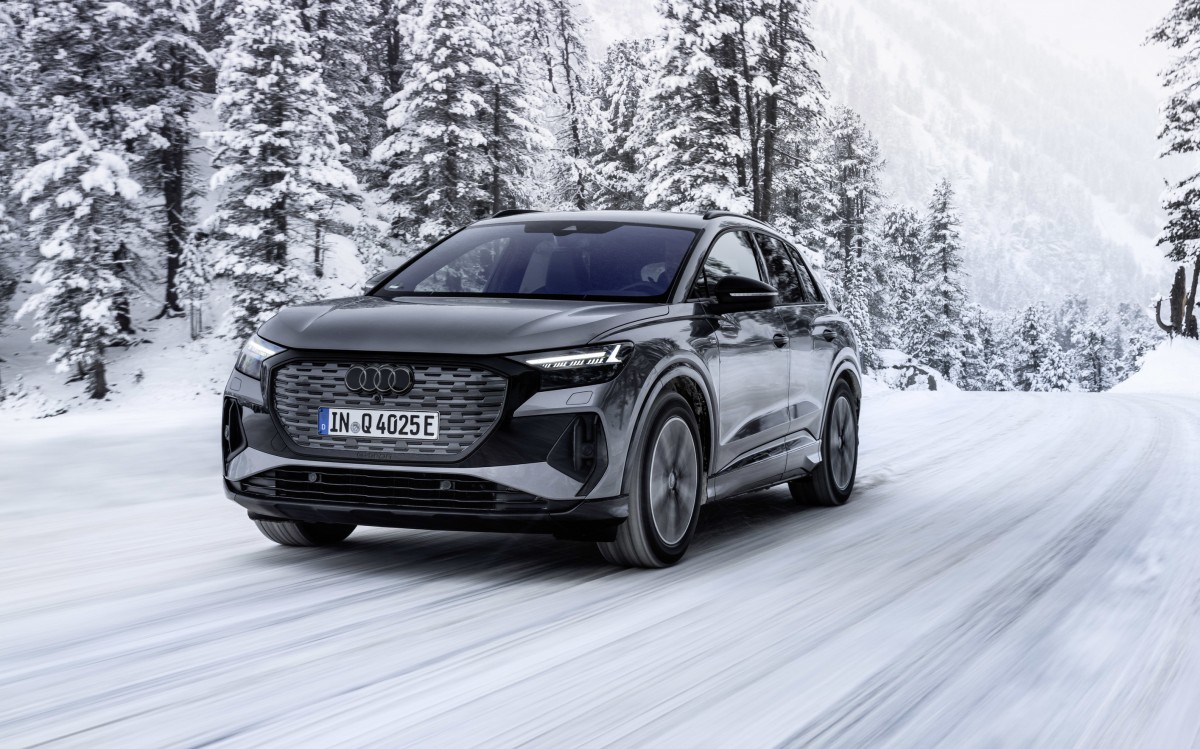
| Audi Q4 e-tron 40 | 14.7 | 18.1 | 23.2 | 470km (292mi) | 77.7% |
| Zeekr 001 4WD YOU | 20.2 | 18.5 | 23.8 | 485km (301mi) | 74.5% |
| IM L7 | 19.2 | 19.4 | 23.6 | 452km (281mi) | 73.5% |
| Rising Auto R7 | 19.3 | 18.9 | 24.4 | 437km (272mi) | 72.1% |
| Nissan Ariya 87kWh | 22.1 | 22.4 | 28.3 | 376km (234mi) | 70.5% |
| Polestar 2 LR FWD | 18.3 | 19.9 | 23.1 | 387km (240mi) | 68.3% |
| Maxus Mifa 9 | 23.5 | 23.0 | 30.3 | 357km (222mi) | 66.2% |
| Cadillac Lyriq RWD | 21.4 | 20.8 | 25.4 | 427km (265mi) | 65.4% |
| Volvo XC40 Recharge SR RWD | 19.0 | 19.7 | 24.7 | 331km (206mi) | 60.2% |
| Arcfox aS HI | 24.1 | 23.8 | 27.8 | 297km (185mi) | 59.3% |
Across most vehicles, the difference in consumption between 30 km/h and 60 km/h is minimal, as increased heating demands offset the benefits of lower aerodynamic drag. However, driving at 100 km/h on highways significantly increases energy consumption, with most models exceeding 20 kWh/100 km—except the BMW i3, which impressively maintained 18.8 kWh/100 km.
For plug-in hybrids (PHEVs) and extended-range EVs, the study found roughly 70% retention of battery range when operating in electric mode.
| Model | Advertised Battery Range | Actual Battery Range | % of Advertised Range |
|---|---|---|---|
| Geely Emgrand L Leishen Hi-P | 100 km / 62 mi (NEDC) | 55 km / 34 mi | 54.6% |
| Changan Deepal SL03 | 200 km / 124 mi (CLTC) | 136 km / 85 mi | 68.2% |
| Haval H6 | 110 km / 68 mi (NEDC) | 73 km / 45 mi | 66.3% |
| BYD Song Plus | 110 km / 68 mi (NEDC) | 94 km / 58 mi | 85.2% |
| Geely Monjaro Hi-P | 245 km / 152 mi (CLTC) | 167 km / 104 mi | 68.3% |
| Wey Mocha | 175 km / 109 mi (CLTC) | 149 km / 93 mi | 85.0% |
| AITO M5 | 170 km / 106 mi (CLTC) | 133 km / 83 mi | 78.4% |
| Lynk & Co 09 | 190 km / 118 mi (CLTC) | 140 km / 87 mi | 73.8% |
| AITO M7 | 200 km / 124 mi (CLTC) | 125 km / 78 mi | 62.3% |
| Li L8 | 210 km / 130 mi (CLTC) | 152 km / 94 mi | 72.2% |
| Li L9 | 215 km / 134 mi (CLTC) | 153 km / 95 mi | 71.0% |
For further details, watch the original video (in Chinese with English subtitles).
If your vehicle is not listed, use our range estimation tool that provides realistic real-world range predictions across various temperatures, including down to -30 °C, and driving speeds. This tool covers a broader selection of vehicles available in Western markets.


