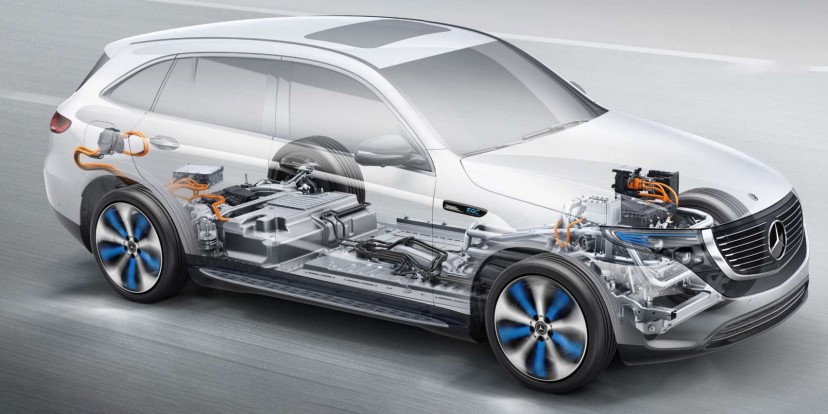
When exploring internal combustion engine technology, one encounters numerous complex concepts and variations—from naturally aspirated and turbocharged engines to different injection systems and combustion cycles. This diversity arises because no single design has yet achieved optimal efficiency. But how does this variety compare to electric motors in e-mobility? Fortunately, electric vehicles typically use just three primary types of motors. Let’s take a closer look at each.
Asynchronous Induction Motor – A Brief History
The asynchronous induction motor, a foundational technology, was independently invented by Nikola Tesla and Galileo Ferraris. Although Ferraris developed the motor in 1885, Tesla was the first to patent it in 1888.
The induction motor revolutionized the use of electricity in powering machines. Today, it remains one of the most widely used motor types, essential in countless electric devices and industrial applications.
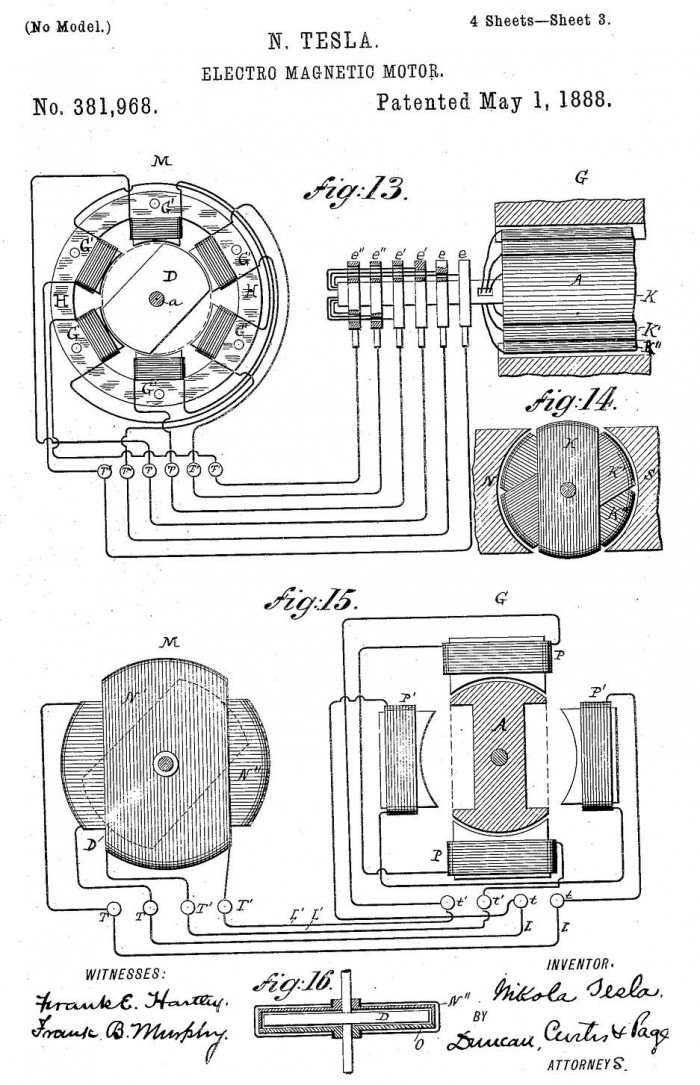 Nikola Tesla’s historic patent of the induction motor
How Does an Asynchronous Induction Motor Work?
Electric motors consist of two main parts: the stator (stationary) and the rotor (rotating). The stator is typically a steel cylinder with slots housing carefully arranged copper coils. These coils receive three-phase alternating current (AC), converted from the battery's direct current (DC) by power electronics, generating a rotating magnetic field known as synchronous speed.
In operation, AC applied to the stator coils produces this rotating magnetic field, which induces voltage in the rotor, causing current to flow. This current generates its own magnetic field in the rotor, which lags behind the stator’s field. The interaction between the two magnetic fields creates the Lorentz force, causing the rotor to turn. The rotor’s motion then drives the vehicle’s wheels through a reduction mechanism.
This motor is called asynchronous because the rotor's magnetic field does not rotate exactly in sync with the stator's field. When accelerating, the rotor's magnetic field lags slightly behind the stator’s; during regenerative braking, the rotor’s field leads the stator’s field. This difference, called "slip," typically ranges up to 5%, depending on motor design.
Three-phase asynchronous induction motors in automotive use typically achieve about 90% efficiency. Their robustness, simplicity, long lifespan, and lack of reliance on rare earth materials make them ideal for industrial uses and as front motors in all-wheel-drive electric vehicles.
Advantages
- Good efficiency
- Cost-effective manufacturing
- No rare earth materials required
- Exceptional reliability
Disadvantages
- Higher cooling requirements
- Lower power density compared to other motors
- Relatively lower efficiency
Vehicles utilizing asynchronous induction motors include the Audi e-Tron SUV, Mercedes-Benz EQC, Tesla Model S, 3, X, and Y (on front axles), and VW Group MEB platform cars (front axles).
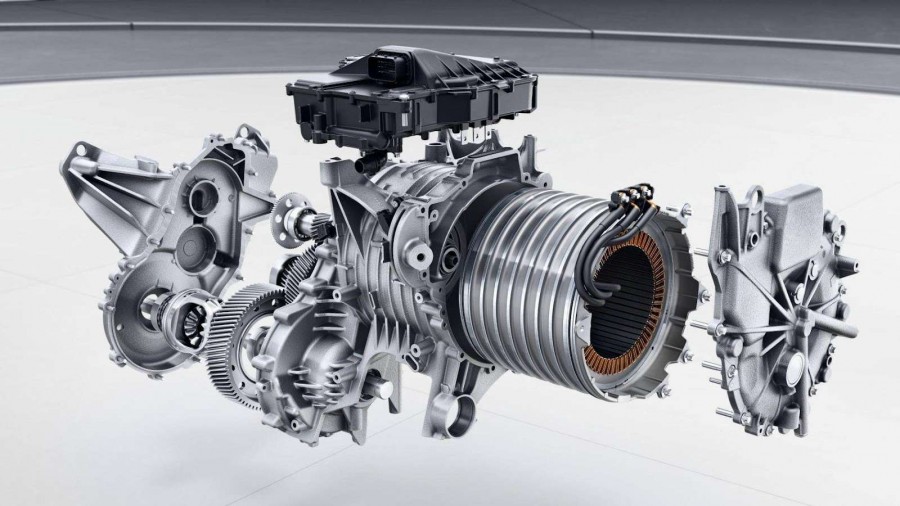 Induction motor used in Mercedes-Benz EQC
Synchronous Permanent Magnet Motor
The key difference between asynchronous induction and synchronous permanent magnet motors lies in their magnetic fields. Permanent magnet synchronous motors have a rotor equipped with permanent magnets, which produce a native rotating magnetic field. The rotor’s and stator’s magnetic fields rotate in perfect synchronization, with no slip.
The use of permanent magnets significantly boosts power density and efficiency. This compact, powerful design is especially suited for plug-in hybrids (PHEVs), where space constraints require motors with high power in a small volume—often integrated into the gearbox.
However, these magnets rely on rare earth materials, largely sourced from China, raising concerns over ethical mining practices. Despite attempts to reduce rare earth usage, synchronous permanent magnet motors remain the most efficient, reaching 94-95% efficiency. This makes them the preferred choice for single-motor electric vehicles.
Advantages
- Very high efficiency
- Lower cooling requirements
- High power density
Disadvantages
- Higher production cost
- Dependence on rare earth materials
- Potential risk of demagnetization
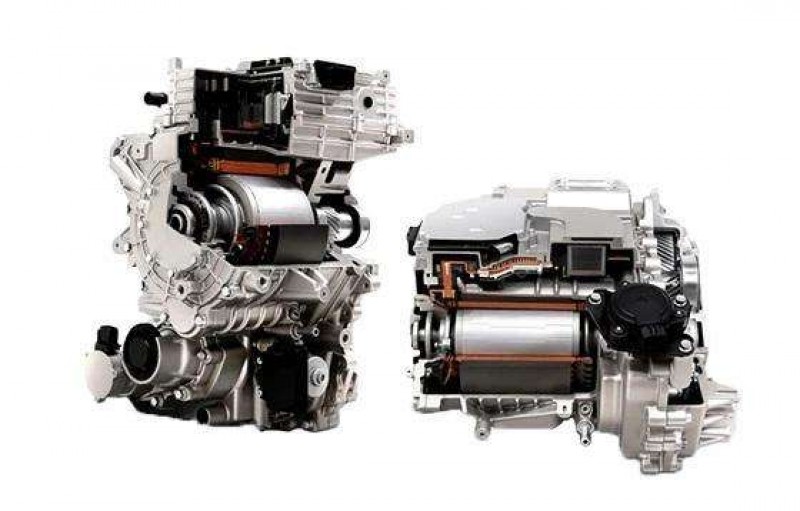 Hyundai Ioniq 5 permanent magnet motors
Permanent magnet motors power the rear axles of models such as the Hyundai Ioniq 5, Tesla Model S, 3, X, and Y, VW Group MEB cars, Jaguar I-Pace, Audi e-tron GT, and Porsche Taycan.
Electrically Excited Synchronous Motor
While permanent magnet synchronous motors offer outstanding efficiency, challenges around rare earth materials have led some manufacturers—such as BMW, Renault Group, and Smart—to adopt an alternative: electrically excited synchronous motors (EESM) that do not require rare earth magnets.
Instead of permanent magnets, these motors use brushes and slip rings to induce current in the rotor’s field windings. BMW reports efficiencies of up to 93%, comparable with permanent magnet motors. However, the use of brushes introduces potential maintenance issues over time, requiring durable brush designs to ensure longevity.
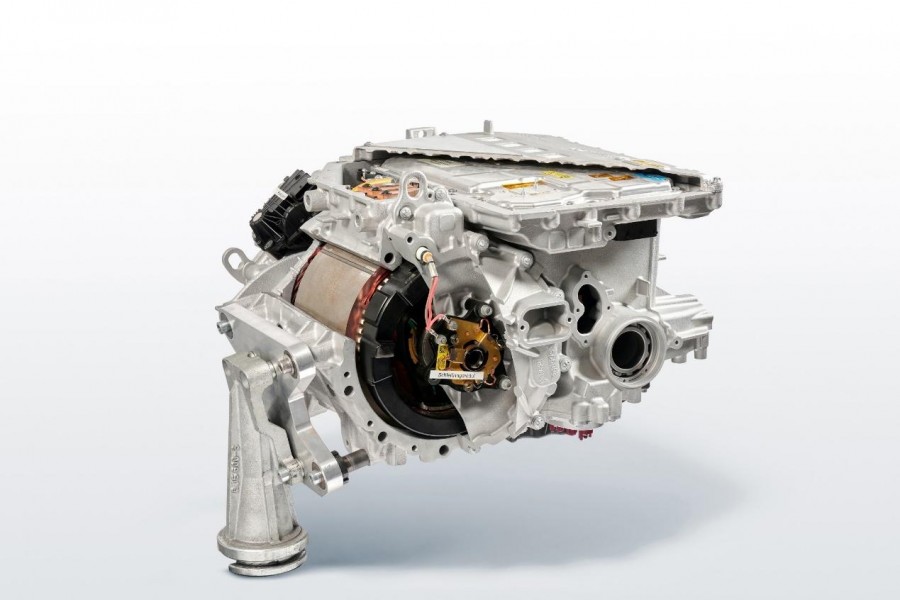 BMW electrically excited synchronous motor
Advantages
- High efficiency
- Lower production costs than permanent magnet motors
- No rare earth material dependency
- No demagnetization risk
Disadvantages
- Brush wear may affect long-term reliability
This motor type is currently used in the BMW iX3, iX, and i4; Renault Megane E-TECH; and Smart EQ models.


