Shortly after the New Year, Oppo launched three Reno15 models globally and in India. We had the opportunity to spend time with all three variants, although it's important to note that there are regional differences in their names: the Reno15, Reno15 Pro, and Reno15 Pro Max.
Here, we focus on the standard model, the Oppo Reno15, which features a 6.59” display. This size is larger than the 6.32” displays found in the Pro and Pro Mini models, yet smaller than the 6.78” display of the Pro Max. Notably, the battery capacity matches that of the Pro Max at 6,500mAh.
 The Reno15 family: Reno15 Pro (left), Reno15 (center) and Reno15 Pro Max (right)
Unlike the “Pro” models, the Reno15 is equipped with a 50MP main camera, utilizing a Sony IMX882 sensor behind an f/1.8 lens with optical image stabilization (OIS). This setup allows for 4K video recording at 60fps. The ultra-wide camera is downgraded to an 8MP OV08D sensor, in contrast to the 50MP cameras featured in the Pro series.
However, the telephoto and selfie cameras tell a different story. The 3.5x/80mm telephoto module boasts a 50MP Samsung JN5 sensor with an f/2.8 OIS lens, similar to that of the Pro models. The 50MP selfie camera, which is also a JN5 sensor, maintains the same specifications, including a 100°/18mm ultra-wide lens and the ability to record 4K video at 60fps.
Another notable aspect of the Reno15 is its processing power, which relies on the Snapdragon 7 Gen 4 chipset. This unit does not compare to the Dimensity 8450 found in the Pro models, and may even perform worse than the Dimensity 8350 used in the Reno14—a point we'll delve into in our future assessments. All models come with non-expandable UFS 3.1 storage options of either 256GB or 512GB.
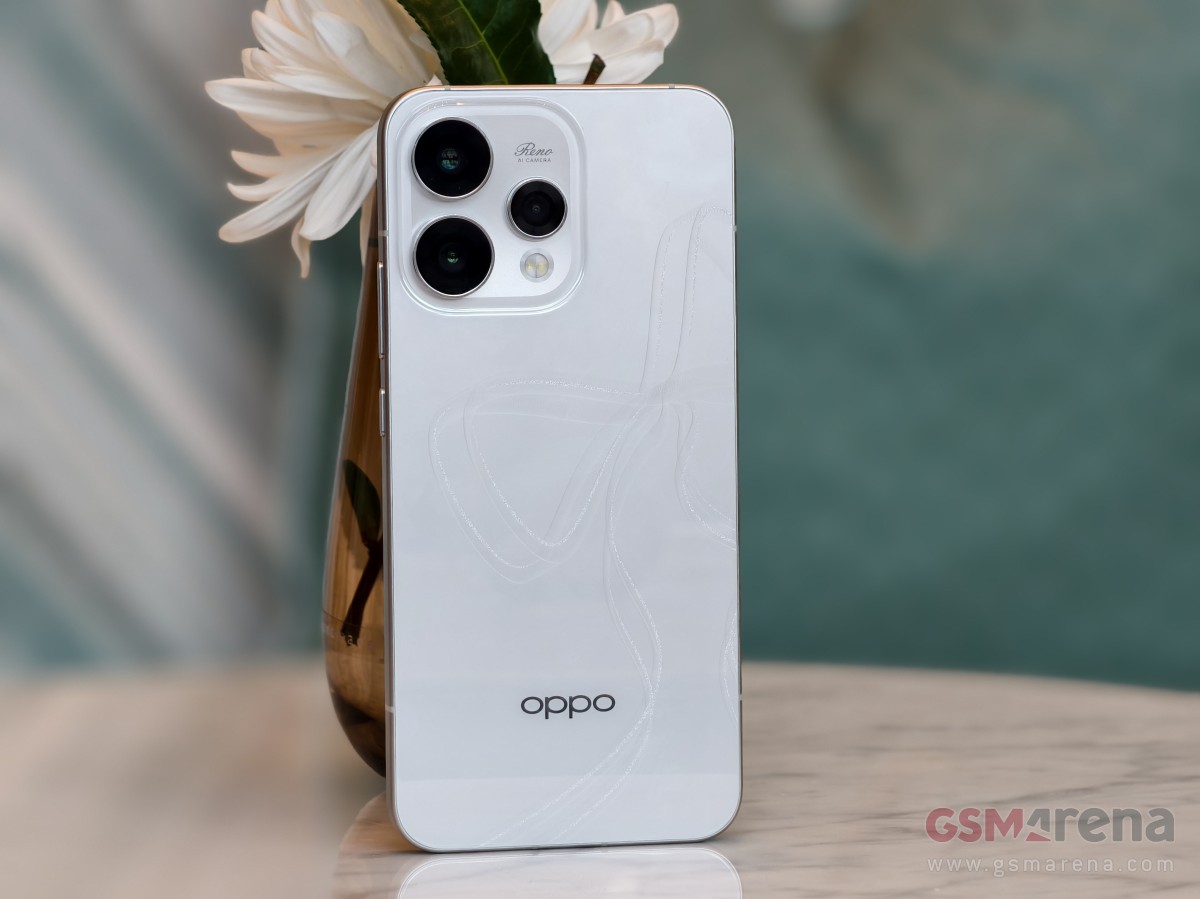 Oppo Reno15
We have the Glacier White variant of the Oppo Reno15, which features a unique glossy coating that gives it a ceramic-like feel. Beneath this, the glass exhibits a fine texture that can be seen from certain angles and disappears from others.
The device utilizes a chassis made from aerospace-grade aluminum, measuring 7.7mm thick and weighing 197g. It's worth noting that the Aurora Blue model is slightly thicker at 0.2mm due to a different coating on the back.
The USB-C port at the bottom has a platinum coating for corrosion resistance. The phone is rated IP66 (splash resistant), IP68 (submersion resistant), and IP69 (resistant to water jets). While there is no headphone jack, stereo speakers are integrated into the design.
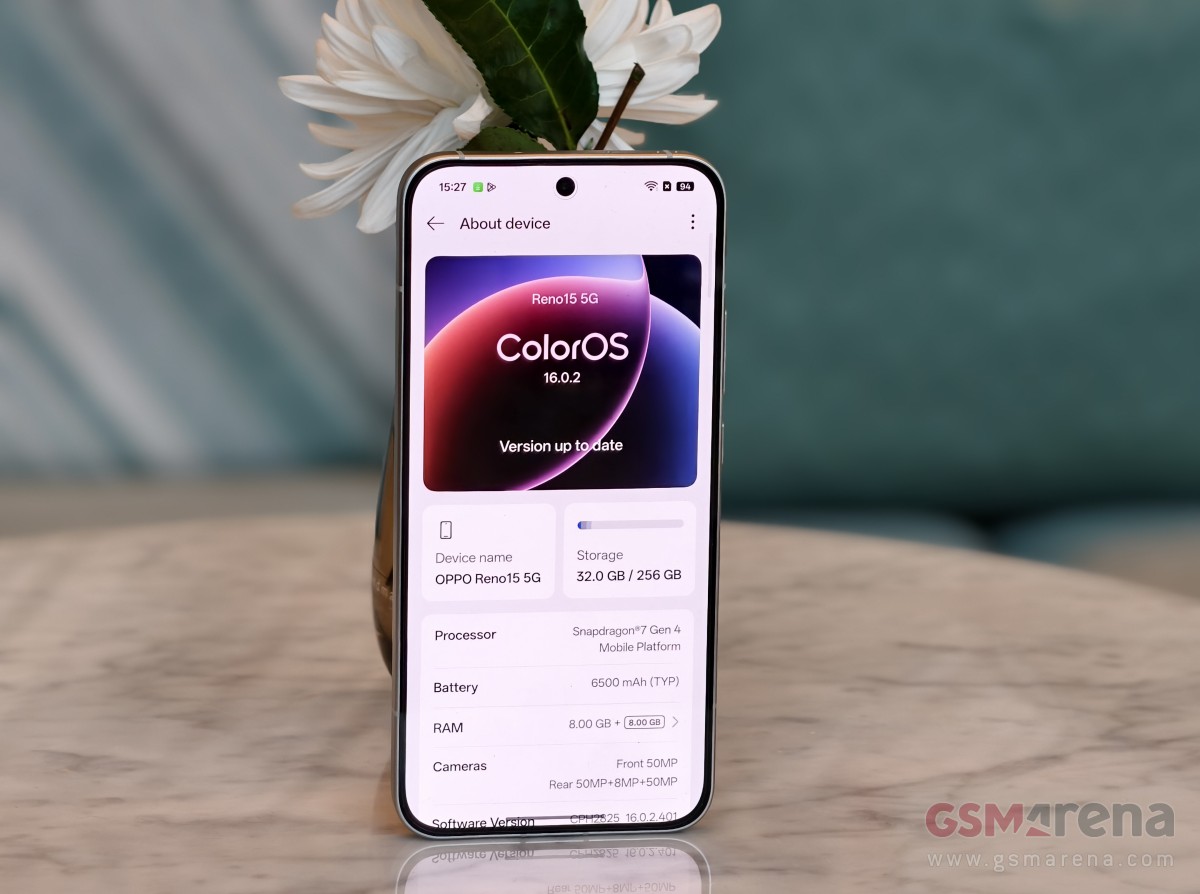 Oppo Reno15
All three Reno15 models come with optical under-display fingerprint readers, which we found to be both fast and accurate during our brief test. The side features three buttons: a volume rocker and a power button, both of which offer a satisfying tactile feedback.
The Reno15's 6,500mAh battery is compatible with 80W fast charging, and Oppo includes a SuperVOOC charger in the retail package, claiming that a full charge from 0-100% takes just 50 minutes. It remains to be seen if this charger will be available in all regions. If you opt for a USB PPS charger, charging speeds can reach up to 55W—a step up from the Reno14, which also had 80W SuperVOOC but limited to 33W with PPS.
We are also eager to explore ColorOS 16, which supports O+ Connect for convenient file transfers and remote control of PC systems, compatible with Windows and Apple devices (iOS, iPadOS, and macOS). Oppo promises five major updates for ColorOS and six years of security patches for the Reno15.
With the Reno15 now in our office, we will begin conducting detailed testing shortly, alongside additional devices from Oppo, so stay tuned for more updates.


