
Owning an internal combustion engine (ICE) vehicle generally requires little knowledge about the refueling process—it's straightforward. However, with electric vehicles (EVs), understanding the charging process is essential for an optimal user experience.
When refueling an ICE vehicle, you typically wait two to three minutes, pay based on the amount of fuel dispensed, and you're on your way. In contrast, charging an EV often takes place at home, necessitating knowledge about your electrical installation and vehicle equipment. At public charging stations, it’s important to know both the charger's maximum power output and your vehicle's charging capacity. Let's delve into the topic of EV charging.
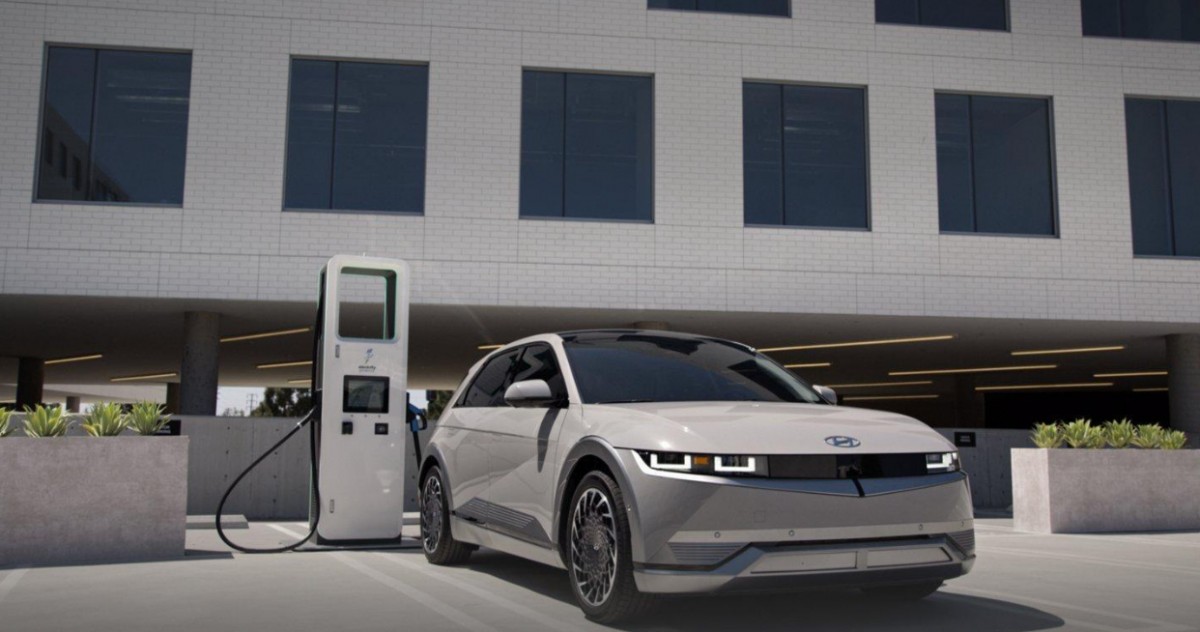 Hyundai Ioniq 5 at a public AC/DC charging station
AC Charging
The majority of EV charging sessions are of the alternating current (AC) variety. The principle is straightforward: whether at home or a public station, AC current is supplied. The vehicle's on-board charger then converts this AC electricity into direct current (DC) to charge the battery.
To ascertain the maximum charging power your EV can receive, you need to understand two key aspects: the specifications of your home electrical installation or public interface, and the specifications of your vehicle's on-board charger.
Home electrical installations may be single-phase or three-phase. For single-phase systems, power is calculated as follows: P = V × I. In Europe, single-phase voltage is typically 230V. For instance, if the voltage is 230V and the current is 32A, the charging power would be 7.36 kW (230V × 32A). For three-phase systems, with a voltage of 400V and 32A current, the calculation becomes P = V × I × √3 = 400V × 32A × 1.732 = 22 kW. This indicates that three-phase installations can provide significantly more power than single-phase setups.
 Mercedes-Benz EQS domestic AC charging station
Now, let’s consider the car. If your vehicle's on-board charger can accommodate the electrical installation’s power, then it will receive the maximum amount of energy. For example, if a Mercedes-Benz EQS is equipped with the 22 kW optional on-board charger, it can utilize the full capacity of a three-phase electrical installation, charging at 22 kW when connected to a compatible wallbox. However, if you connect the vehicle to a Schuko (Type F) plug with a typical 10A current, you would only receive a mere 2.3 kW.
To estimate the charging time for your vehicle, you need to know the net energy capacity of your battery (in kWh) and the effective charging power. For instance, if your car has a 50 kWh battery and employs an 11 kW on-board charger with a typical charging efficiency of 94%, the theoretical charging time is calculated as 50/(11 × 0.94), which amounts to approximately 4 hours and 50 minutes. This theoretical time may vary depending on the vehicle's unique charging curve, which influences actual performance, particularly with home installations that generally yield closer to expected results.
 *Assumption: Vehicle consumption 18 kWh/100 km
DC Charging
DC charging simplifies the process significantly. Since DC chargers supply direct current that matches the battery's requirements, the on-board charger becomes irrelevant. The maximum charging power a battery can receive is determined by its specifications and the rapid charger's capabilities.
Typically, EV batteries operate at 400V; however, modern vehicles often utilize architectures exceeding 800V, such as the Porsche Taycan, Audi E-Tron GT, Hyundai Ioniq 5, and Lucid Air. These models can achieve charging power of up to 350 kW when paired with appropriate 800V chargers.
 Audi e-tron GT can charge with up to 270 kW DC
Charging effectiveness is also impacted by battery cooling systems. Most contemporary EVs feature liquid-cooled batteries to manage the thermal load associated with rapid charging. In contrast, cars that utilize passive air-cooling methods typically limit DC charging to 50 kW to prevent the risk of overheating the battery pack.
Manufacturers generally recommend charging EVs to a maximum of 80% capacity using DC chargers to minimize battery wear, since charging beyond 80% often results in a significant decrease in power output, making it inefficient to charge further.
 *Assumption: Vehicle consumption 18 kWh/100 km
A Missed Opportunity?
The charging process could be fundamentally more streamlined if electric vehicles relied solely on DC charging. While this perspective may be contentious, eliminating the on-board charger would simplify vehicle design, reducing both cost and weight, while also negating the need for cables in the trunk or frunk.
In residential settings, owners could opt for DC wallboxes with maximum power output similar to AC wallboxes, typically rated at 22 kW. Though commercially available today, DC domestic wallboxes are significantly more expensive—five to seven times the cost of AC versions. Nonetheless, if all manufacturers transitioned to exclusively DC charging, economies of scale would likely lower the prices for domestic DC chargers considerably.
This crucial decision to standardize EV charging on DC should have been made at the inception of the e-mobility era; regrettably, it has not, marking it as one of the significant missed opportunities in the evolution of electric mobility.
 ABB 24 kW DC wallbox


