
For owners of internal combustion engine (ICE) vehicles, a basic understanding of the refueling process is often sufficient due to its simplicity. However, if you own an electric vehicle (EV), it's crucial to familiarize yourself with the charging process, as it significantly affects user experience.
When refueling an ICE vehicle, the process typically takes only a few minutes—you pay for the amount of fuel received and you're ready to go. In contrast, with EVs, charging often occurs at home, necessitating an understanding of your home’s electrical installation and your vehicle’s equipment. Knowledge of a public charging station's maximum charging power, as well as your car’s limits, is also essential. Let’s clarify the topic of EV charging.
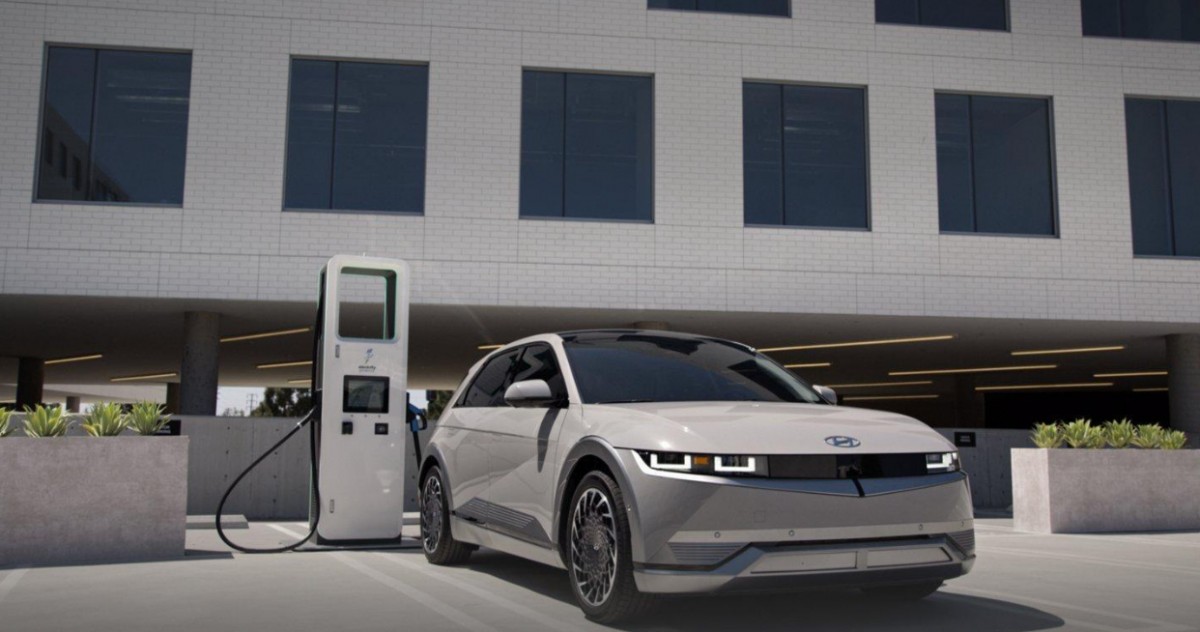 Hyundai Ioniq 5 at a public AC/DC charging station
AC Charging
The majority of EV charging sessions are AC charging. The principle is straightforward: both domestic and public charging stations provide alternating current (AC), which the on-board charger in the vehicle converts to direct current (DC) for battery charging.
To determine your car's maximum charging power, you must consider two factors: the electrical specifications of your home installation or public charging point and the relevant specifications of your vehicle's on-board charger.
Home electrical installations can be single-phase or three-phase. For single-phase systems, power is calculated as follows: P = V * I. In Europe, the standard voltage is 230V. Thus, if your installation provides 230V at 32A, the charging power is 7.36 kW (230V * 32A). For a three-phase system, the calculation is: P = V * I * √3 = 400V * 32A * 1.732 = 22 kW. Clearly, a three-phase installation can supply significantly more power than a single-phase one.
 Mercedes-Benz EQS domestic AC charging station
Now let’s consider your vehicle. If the on-board charger is compatible with the electrical installation, the power supplied to the car will match. For example, if you have a Mercedes-Benz EQS equipped with the optional 22 kW on-board charger, you can utilize a three-phase electrical installation fully, charging at 22 kW using the appropriate wallbox. However, if you have a three-phase installation and connect to a Schuko (Type F) plug with a typical 10A current, you will only achieve 2.3 kW.
To estimate charging time, you need to know your battery's net energy content in kWh and the net charging power. For example, a vehicle with a 50kWh battery and an 11kW on-board charger, with a charging efficiency of 94%, would take approximately 4 hours and 50 minutes to charge: 50/(11*0.94). This time can vary based on the vehicle's unique charging curve, but you'll usually approach the expected duration with home installations due to their lower output.
 *Assumption: Vehicle consumption 18 kWh/100 km
DC Charging
When it comes to DC charging, the process is much simpler. DC chargers provide direct current (DC) to the battery, rendering the on-board charger irrelevant. The maximum charging power depends on the battery's specifications and the rapid charger’s capabilities.
Typically, batteries operate on 400V, but newer models like the Porsche Taycan, Audi E-Tron GT, Hyundai Ioniq 5, and Lucid Air employ 800V+ architectures, allowing charging power of up to 350 kW with compatible chargers.
 Audi e-tron GT can charge with up to 270 kW DC
Charging power is also influenced by battery cooling systems. Many modern vehicles come equipped with liquid-cooled batteries essential for managing the thermal load associated with rapid charging. Conversely, cars with passive air-cooling systems typically limit their DC charging power to around 50kW to prevent excessive battery temperatures.
Manufacturers often recommend charging up to 80% when using DC, as battery wear increases beyond this point, and charging efficiency drops significantly beyond 80%, making further charging less efficient.
 *Assumption: Vehicle consumption 18 kWh/100 km
A Missed Opportunity?
The charging process would be considerably more straightforward if only DC charging were utilized for electric vehicles. While this notion might seem controversial, eliminating the need for an on-board charger would lead to cheaper and lighter vehicles, along with no requirement for charging cables.
In residential settings, owners could employ DC wallboxes with a maximum power of 22 kW, akin to the existing AC wallboxes. Although DC domestic wallboxes are available today, they are five to seven times more expensive than AC wallboxes. If manufacturers had primarily adopted DC charging, economies of scale could have reduced domestic DC charger prices significantly.
This decision arguably represents one of the greatest missed opportunities in the evolution of e-mobility.
 ABB 24 kW DC wallbox


