In a groundbreaking announcement, Google has revealed that the Chrome browser on the latest Android devices is leading the pack in mobile web browsing speed. By utilizing industry-standard benchmarks, Speedometer 3.1 and LoadLine, Google has demonstrated that Chrome on Android not only excels in performance but also surpasses Safari on iOS, setting new speed records.
Benchmarking the Browsing Experience: Speedometer 3.1 and LoadLine
Speedometer 3.1 is designed to simulate typical browser usage, measuring how quickly browsers can execute complex tasks found in everyday web interactions. This benchmark mimics user actions such as pressing buttons, scrolling, and typing, providing insights into the responsiveness that users can expect when navigating complex sites like Facebook, Gmail, and Google Docs. LoadLine, on the other hand, accurately assesses how quickly webpages load after a user clicks on a link, testing popular real-world websites across categories like news, shopping, and search engines.
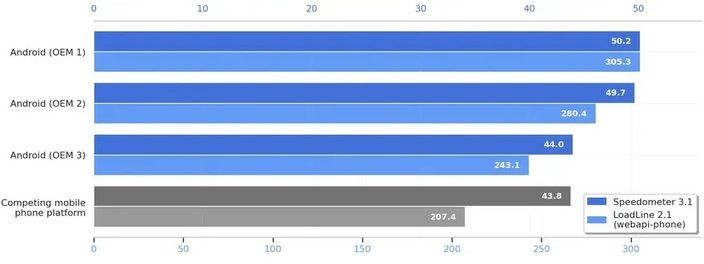
Recent data from LoadLine underscores Android's newfound superiority in mobile browsing, with flagship Android devices scoring as much as 47% higher compared to their iOS counterparts. Google attributes this achievement to the seamless integration of hardware, the Android OS, and the Chrome browser engine.
Collaboration on Performance: Google and Android Partners
To ensure these impressive results, Google has encouraged its Android partners to evaluate and optimize their devices based on the Speedometer and LoadLine benchmarks. This has led to significant year-over-year improvements, with flagship Android phones achieving Speedometer and LoadLine scores that are 20% to 60% higher. Consequently, users can expect pages to load 4% to 6% faster, with high-percentile interactions improving by 6% to 9%.
According to the latest statistics from Google, three flagship Android phones showcased an average Speedometer 3.1 score of 48.2, outperforming a competing mobile platform, likely an iPhone, which scored 43.8. For LoadLine, these Android devices averaged 276.3, significantly higher than the 207.4 achieved by the iPhone on iOS. Speculation suggests that the top-performing Android devices may include the Pixel 10 Pro, Galaxy S26 Ultra, and Xiaomi 16.