The Federal Communications Commission (FCC) has implemented new regulations designed to accelerate the transition from outdated copper lines to advanced high-speed network technologies across the United States. However, the shift may not provide equal benefits to all Americans, particularly those residing in rural regions or individuals with specific needs. The latest rules facilitate the process for telecommunications companies to replace aging copper infrastructure with modern fiber-optic and 4G/5G wireless technologies.
Reasons Behind the FCC's Push for Modernization
FCC Chairman Brendan Carr has communicated the necessity for telecom providers to upgrade from copper lines to more efficient, high-speed networks. He states, "For too long, outdated rules and regulations have forced providers to maintain aging copper infrastructure and to keep consumers on broken, antiquated networks."
Per the FCC's analysis, this transition has the potential to save U.S. telecom companies "tens of billions" annually, which can then be redirected towards expanding high-speed Internet Protocol (IP) networks. High-speed networks can manage enormous data volumes with low latency, enabling advanced technologies such as autonomous vehicles and intelligent AI that streamlines complex tasks.
For instance, if a flight is canceled at the airport, intelligent AI can promptly assess the situation through various channels, managing to book a new flight and taking care of hotel arrangements with minimal user intervention.
Financial Benefits of Removing Outdated Infrastructure
The FCC emphasizes that eliminating copper lines will conserve resources for carriers, allowing them to avoid unnecessary expenditure on outdated networks plagued by declining subscriber numbers. In a Report and Order issued recently, the FCC aims to minimize regulatory burdens, enabling wireless providers to allocate funds towards modernizing their infrastructure.
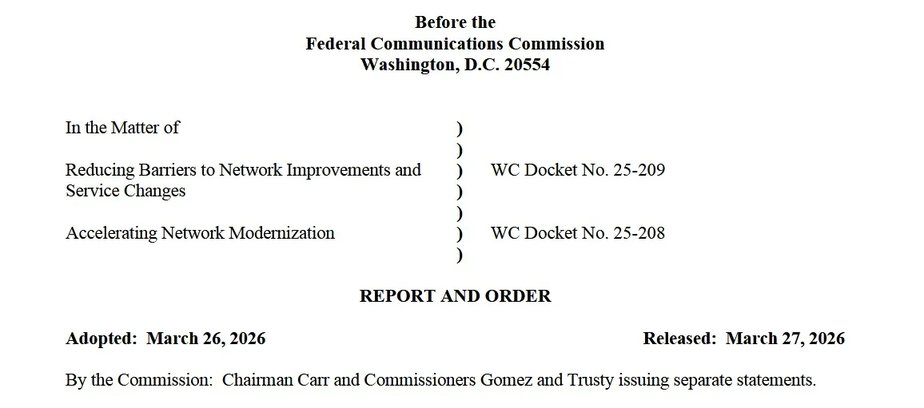
The FCC's Report and Order has simplified the regulatory process for providers. | Image by FCC
The recent Order reduces the number of filings required when carriers make changes, such as removing copper lines. Wireless providers are now only required to publish a public notice on their websites to announce network changes, although the FCC must still authorize the retirement of copper lines or other modifications that would interrupt service.
Under the new regulations, telecom companies can dismantle copper lines without needing to provide evidence that alternatives perform at an equivalent level. Previously, firms that could not demonstrate this were mandated to offer voice services as a distinct, standalone subscription.
Regulatory Preemption Concerns Highlighted by the FCC
The FCC's order grants telecommunications companies the ability to "grandfather" legacy plans that provide voice and low-speed broadband services, meaning that new subscribers will not have access to these outdated offerings. Critics are worried that the removal of copper lines and legacy services could negatively impact rural customers, the elderly, and individuals reliant on older phone systems for vital medical equipment.
Similar concerns in the U.K. led BT to postpone plans to decommission the public switched telephone network (PSTN) in favor of fiber optics due to protection mandates for users of the TeleCare system, which alerts caregivers during emergencies involving elderly individuals.
The FCC asserts that even if state and local laws require providers to maintain legacy services, these must yield to federal regulations, noting that such state provisions are subject to preemption, especially when the FCC has previously approved applications to terminate legacy services.