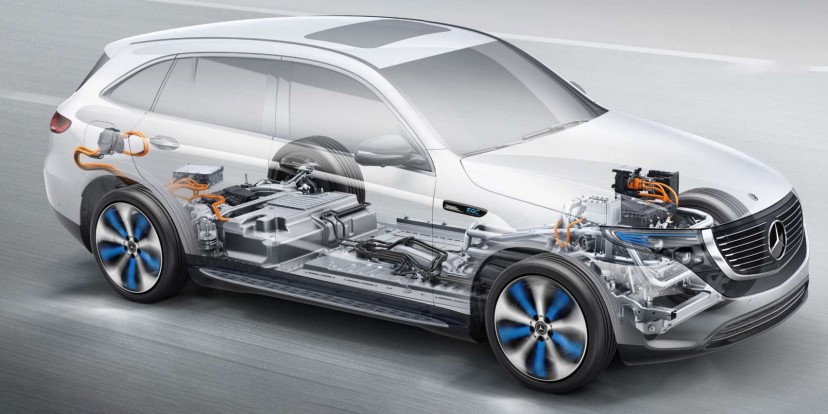
Diving into internal combustion engine technology reveals a plethora of concepts: naturally aspirated, turbocharged, direct and indirect injection, and more. This array of designs arises from the ongoing challenge of achieving optimal efficiency. But what about electric motors in the realm of e-mobility? Contrary to the multitude of engine types, there are only three predominant electric motor types. Let's explore them.
Asynchronous Induction Motor: A Brief History
The asynchronous induction motor is not a recent innovation. It was independently developed by Nikola Tesla and Galileo Ferraris, with Ferraris being the first to create it in 1885 and Tesla applying for the patent in 1888.
This type of motor is a milestone in the harnessing of electricity, so deeply integrated into modern life that we hardly recognize its ubiquity. Many electrical devices and most industrial motors leverage the efficiency of asynchronous induction motors.
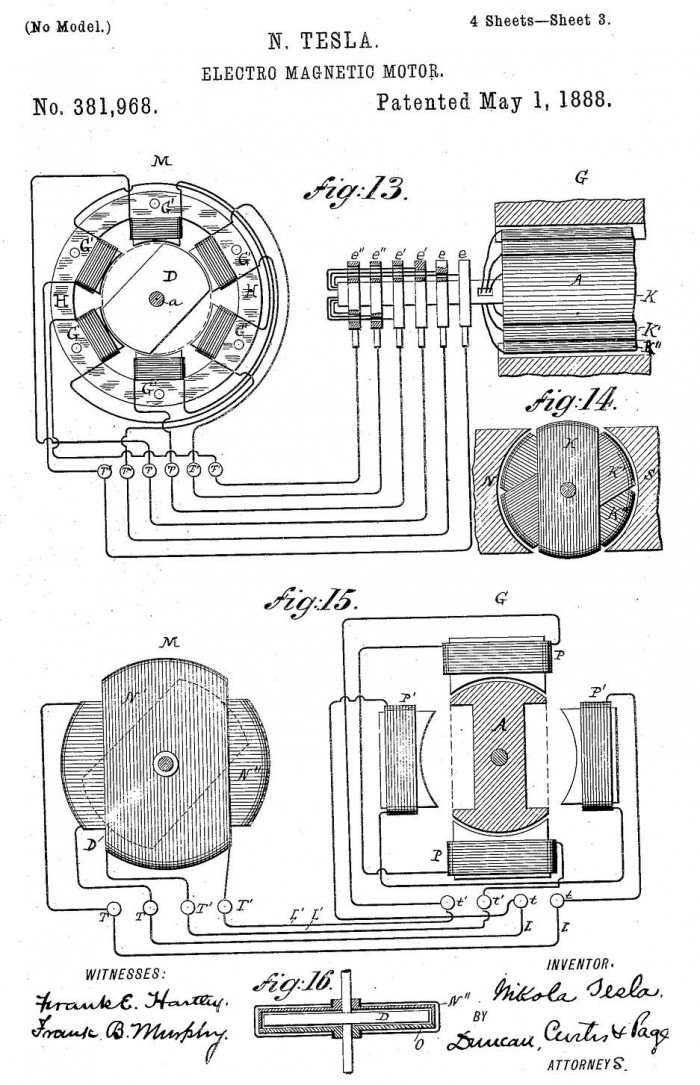 Nikola Tesla’s historic patent of the induction motor
How Does an Asynchronous Induction Motor Work?
Every electric motor comprises two key components: the stator, a static element, and the rotor, which rotates. The stator usually consists of a steel cylinder featuring slots and copper coils arranged in a specific geometry. These coils receive three-phase AC current, converted from DC by power electronics sourced from the battery. This current generates a rotating magnetic field in the stator, with its speed known as synchronous speed.
Here’s a simplified overview of the operation: applying AC voltage to the copper coils creates a rotating magnetic field, inducing a voltage in the rotor. This, in turn, produces a current, generating its rotating magnetic field that lags behind the stator field. The interaction between these two magnetic fields results in the rotor's motion, transmitted to the vehicle's wheels through a reduction gear.
The term 'asynchronous' refers to the fact that the magnetic fields of the rotor and stator are not synchronized. The induction part stems from the voltage and current induced by the stator's rotating magnetic field. When the accelerator is pressed, the rotor's field lags slightly; during deceleration, acting as a generator through regenerative braking, the rotor's magnetic field advances ahead of the stator's. The degree of this difference is termed 'slip,' typically up to 5%, depending on the motor design.
Typical efficiency for a 3-phase asynchronous induction motor in automotive applications is approximately 90%. Thanks to their durability, simplicity, and reliance on common materials, these motors dominate industrial applications and serve well as front motors in all-wheel-drive electric vehicles.
Pros
- Good efficiency
- Cost-effective to manufacture
- No reliance on rare earth materials
- Exceptional reliability
Cons
- Increased cooling requirements
- Lower power density
- Lower efficiency compared to alternative motor types
Examples of vehicles utilizing asynchronous induction motors include the Audi e-Tron SUV, Mercedes-Benz EQC, and the Tesla Model S, 3, X, and Y, all of which deploy these motors mainly on their front axles.
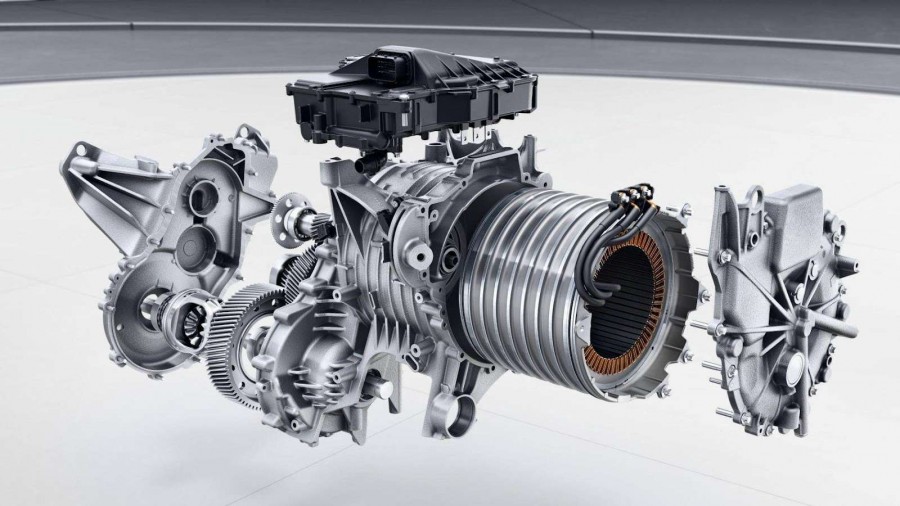 Induction motor used in Mercedes-Benz EQC
Synchronous Permanent Magnet Motor
The primary distinction between asynchronous induction motors and synchronous permanent magnet motors lies in how their rotating magnetic fields interact. Synchronous permanent magnet motors feature a built-in rotating magnetic field created by permanent magnets in the rotor, establishing a lock between the rotating magnetic fields of the rotor and stator—resulting in no slip.
The use of permanent magnets significantly boosts power density and efficiency. This high power density allows for compact design, making these motors ideal for hybrid vehicles where space is at a premium.
However, permanent magnets rely on rare earth materials, predominantly sourced from China, raising ethical sourcing concerns. Despite these challenges, synchronous permanent magnet motors are known for their superior efficiency, reaching up to 94-95%. When only one motor is employed in a vehicle, this is typically the motor used.
Pros
- Exceptional efficiency
- Reduced cooling needs
- High power density
Cons
- High production costs
- Dependence on rare earth materials
- Theoretical risk of demagnetization
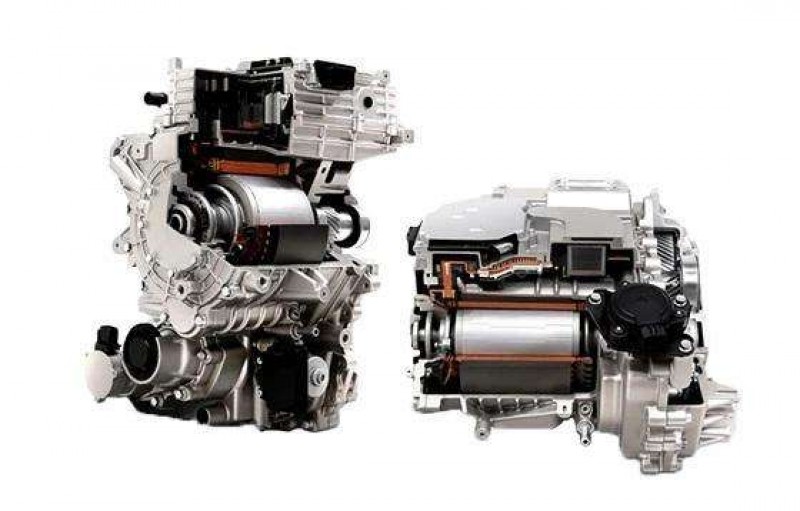 Hyundai Ioniq 5 permanent magnet motors
Permanent magnet motors are utilized in vehicles such as the Hyundai Ioniq 5, Tesla Model S, 3, X, and Y on the rear axles, as well as in several models from the VW Group, Jaguar I-PACE, Audi e-tron GT, and Porsche Taycan.
Electrically Excited Synchronous Motor
While permanent magnet synchronous motors offer unparalleled efficiency, the challenges surrounding rare earth materials are significant. To address this issue, some manufacturers like BMW, Renault Groupe, and Smart are exploring hybrid designs utilizing synchronous motors devoid of rare earth materials.
These motors operate without permanent magnets in the rotor, employing brushes and slip rings instead. BMW claims that their designs can achieve efficiencies of up to 93%, closely mirroring those of permanent magnet motors. However, the reliance on brushes poses long-term reliability concerns, necessitating eventual replacement. Continued development is critical to ensure the longevity of these components.
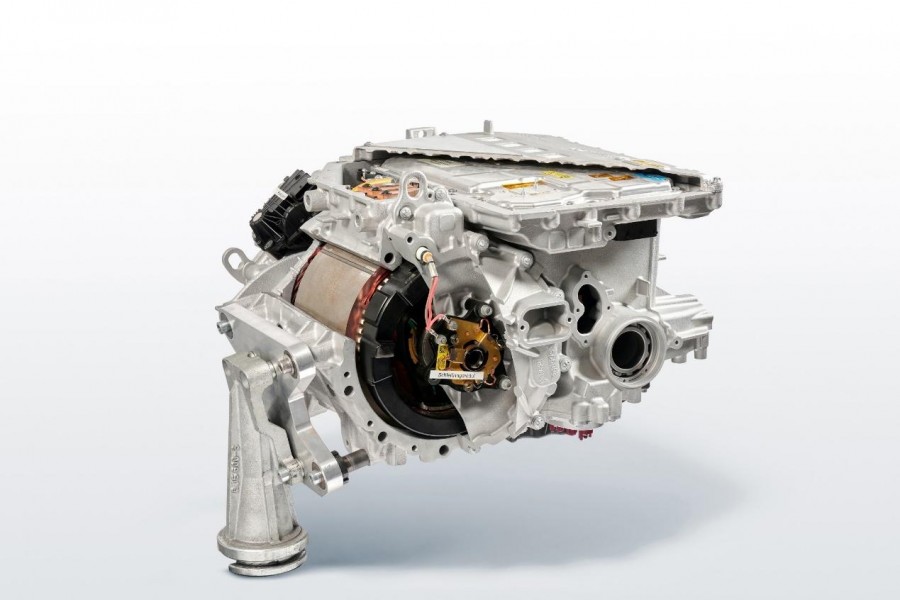 BMW electrically excited synchronous motor
Pros
- High efficiency
- Lower production costs compared to permanent magnet synchronous motors
- No risk of demagnetization
- Exemption from rare earth material requirements
Cons
- Dependence on brush longevity for reliability
This motor type is incorporated in the BMW iX3, iX, i4, Renault Megane E-TECH, and SMART EQ.