Electric vehicles (EVs) often allow remote cabin conditioning so you can enter a warm car on cold days. However, freezing temperatures significantly reduce their driving range. Expecting the officially rated range in cold weather will likely lead to disappointment. But how much range can you realistically expect to lose?
A comprehensive test conducted by Chinese media evaluated a variety of popular electric and plug-in hybrid vehicles to answer this question. While the sample leans heavily on Chinese models, it also includes numerous international brands.
The test was carried out at a moderate cold temperature of 8-10°C, using maximum regenerative braking, climate control set to 25°C in economy mode, all-season tires, and eco-driving mode. Three driving scenarios were tested: city driving at 30 km/h (100 km distance), suburban at 60 km/h (100 km distance), and highway cruising at 100 km/h (153 km distance). Although 8°C is not extremely cold, it effectively illustrates differences among manufacturers and their vehicles’ cold-weather performance.
The BMW i3 eDrive 35L performed exceptionally well, retaining 80.5% of its advertised range at 424 km, ranking first. It was followed closely by the Ford Mustang Mach-E GT and the Nio ET5, which maintained 79.7% and 79.0% respectively.
Among the top 14 electric vehicles tested, most retained 70-80% of their certified range. At the lower end, the Volvo XC40 Recharge SR RWD and the Arcfox aS HI both lost about 40% of their range.
| Model | kWh/100 km @ 30 km/h | kWh/100 km @ 60 km/h | kWh/100 km @ 100 km/h | Actual range | % of advertised range |
|---|---|---|---|---|---|
| BMW i3 eDrive 35L | 15.6 | 15.6 | 18.8 | 424 km / 263 mi | 80.5% |
| Ford Mustang Mach-E GT | 17.4 | 20.5 | 25.0 | 392 km / 244 mi | 79.7% |
| Nio ET5 100 kW | 16.8 | 16.3 | 21.0 | 561 km / 349 mi | 79.0% |
| BMW iX3 | 18.3 | 17.5 | 21.5 | 422 km / 262 mi | 78.8% |
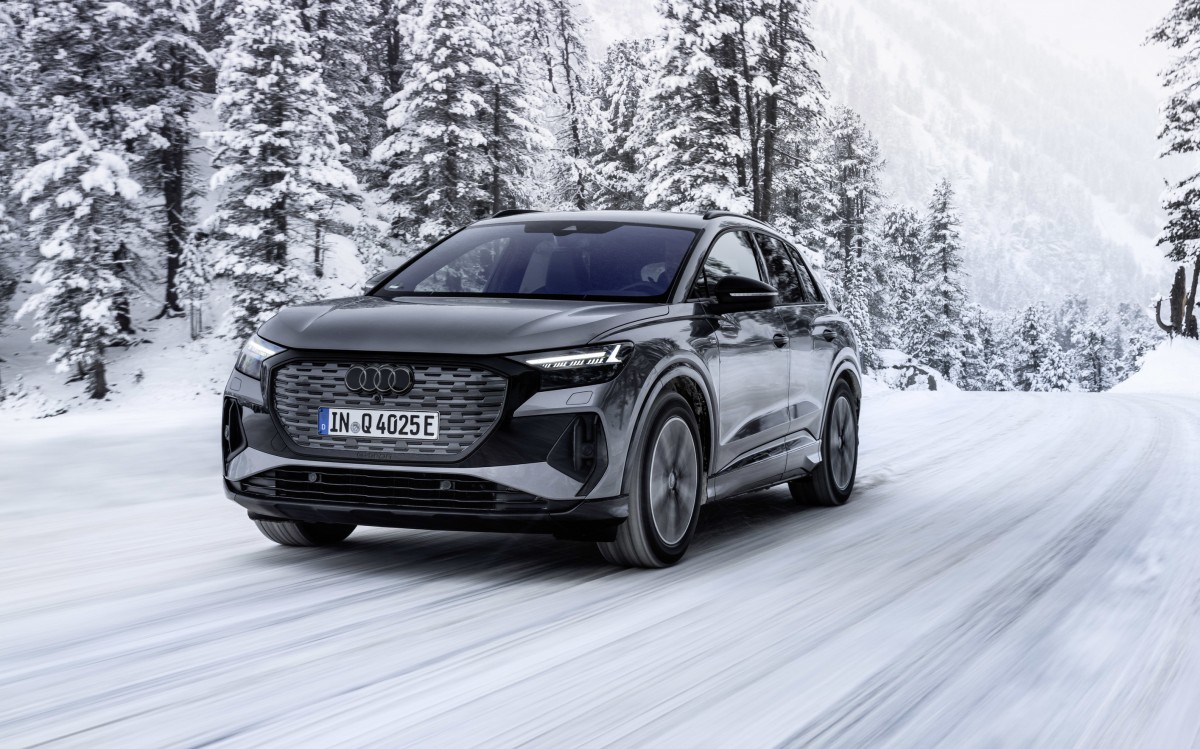
| Audi Q4 e-tron 40 | 14.7 | 18.1 | 23.2 | 470 km / 292 mi | 77.7% |
| Zeekr 001 4WD YOU | 20.2 | 18.5 | 23.8 | 485 km / 301 mi | 74.5% |
| IM L7 | 19.2 | 19.4 | 23.6 | 452 km / 281 mi | 73.5% |
| Rising Auto R7 | 19.3 | 18.9 | 24.4 | 437 km / 272 mi | 72.1% |
| Nissan Ariya 87 kWh | 22.1 | 22.4 | 28.3 | 376 km / 234 mi | 70.5% |
| Polestar 2 LR FWD | 18.3 | 19.9 | 23.1 | 387 km / 240 mi | 68.3% |
| Maxus Mifa 9 | 23.5 | 23.0 | 30.3 | 357 km / 222 mi | 66.2% |
| Cadillac Lyriq RWD | 21.4 | 20.8 | 25.4 | 427 km / 265 mi | 65.4% |
| Volvo XC40 Recharge SR RWD | 19.0 | 19.7 | 24.7 | 331 km / 206 mi | 60.2% |
| Arcfox aS HI | 24.1 | 23.8 | 27.8 | 297 km / 185 mi | 59.3% |
Interestingly, energy consumption at 30 km/h and 60 km/h is quite similar, as the increased heating demand offsets the aerodynamic drag differences. However, highway speeds of 100 km/h significantly increase energy use, with most vehicles consuming well over 20 kWh/100 km. The BMW i3 stands out with an efficient 18.8 kWh/100 km at this speed.
Plug-in hybrid and extended-range electric vehicles examined retained about 70% of their advertised electric range under similar conditions.
| Model | Advertised Battery Range | Actual Battery Range | % of Advertised Range |
|---|---|---|---|
| Geely Emgrand L Leishen Hi-P | 100 km / 62 mi (NEDC) | 55 km / 34 mi | 54.6% |
| Changan Deepal SL03 | 200 km / 124 mi (CLTC) | 136 km / 85 mi | 68.2% |
| Haval H6 | 110 km / 68 mi (NEDC) | 73 km / 45 mi | 66.3% |
| BYD Song Plus | 110 km / 68 mi (NEDC) | 94 km / 58 mi | 85.2% |
| Geely Monjaro Hi-P | 245 km / 152 mi (CLTC) | 167 km / 104 mi | 68.3% |
| Wey Mocha | 175 km / 109 mi (CLTC) | 149 km / 93 mi | 85.0% |
| AITO M5 | 170 km / 106 mi (CLTC) | 133 km / 83 mi | 78.4% |
| Lynk & Co 09 | 190 km / 118 mi (CLTC) | 140 km / 87 mi | 73.8% |
| AITO M7 | 200 km / 124 mi (CLTC) | 125 km / 78 mi | 62.3% |
| Li L8 | 210 km / 130 mi (CLTC) | 152 km / 94 mi | 72.2% |
| Li L9 | 215 km / 134 mi (CLTC) | 153 km / 95 mi | 71.0% |
For more details, watch the original video. Although it is in Chinese, English subtitles are available.
If your vehicle isn’t listed, a useful range estimation tool is available. It predicts real-world EV range across various temperatures, down to -30°C, and different speeds, covering models from Western markets as well.


